(ITA)

Hi everyone and welcome back to this new article on my blog. As I told you last week, for at least for another week, there will be no articles regarding movie reviews, instead there will be kind of articles. In today’s article we’re going to talk about “Mystery” and one the most enigmatic mysteries of last few centuries upon a monument that is located in the heart of Rome, as well as The Alchemic Door.
I hope you like this second article on my blog about mystery.

Among the many Roman Wonders filled with Mystery and Magic that came down to us up to the present day, those wonders that can be full monuments or just part of them or even just ruins filled with history, not everyone knows that in the heart of Rome, in one of the most characteristic quarters of the city,

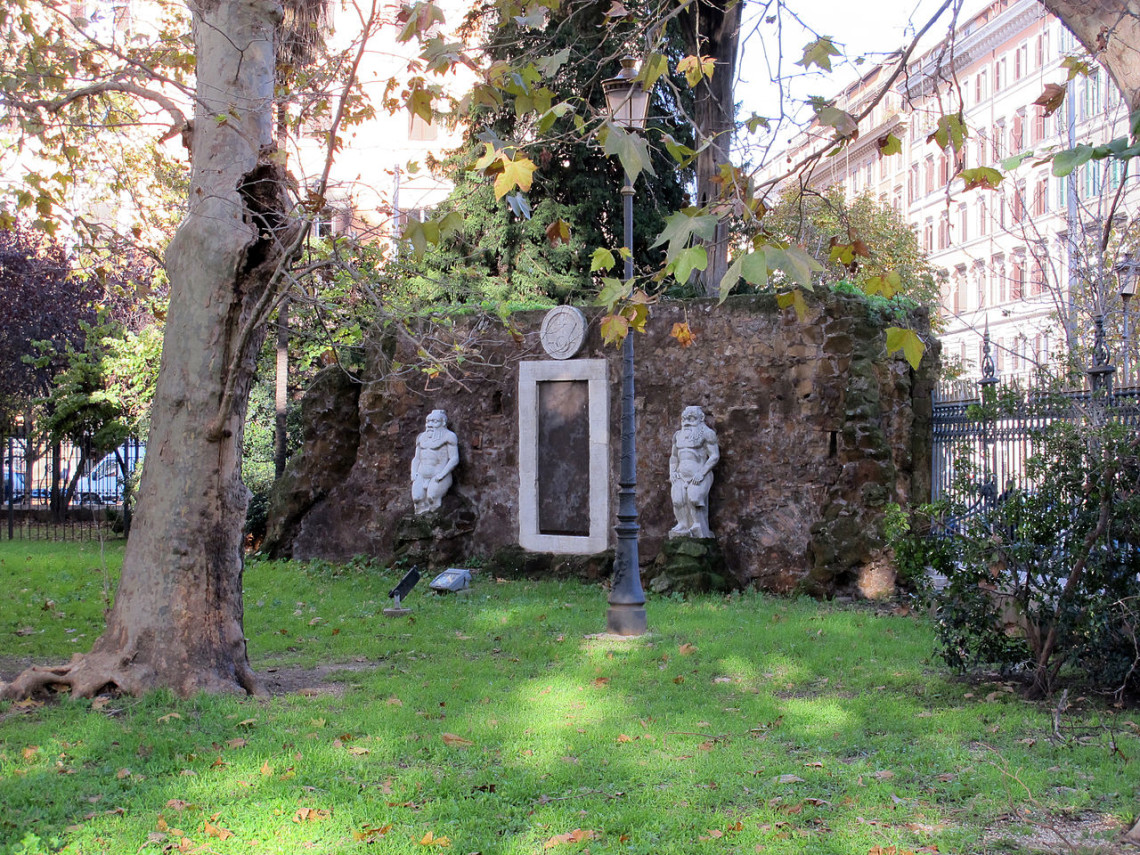
in the gardens of Piazza Vittorio Emanuele II, despite being there under the eyes of all of us to see, you will find a door, a magic door… The Alchemical Door.
Intro

The Alchemical Door, also known as the Alchemy Gate or Hermetic Door or even Magic Portal, is a monument built between 1655 and 1680 by the Marquis of Pietraforte, Massimiliano Savelli Palombara, in his residence, the Villa Palombara.

This ‘Door’ is the only one of five former gates of the villa that still remains. In 1873 the Alchemical Door was disassembled and in 1888 rebuilt inside the gardens of Piazza Vittorio, on an old perimetral wall of the Sant’ Eustachio Church, and on the two sides were added two statues of “monstruous” dwarves that represent the ancient Egyptian demigod Bes.
the Legend:

According to a story, collected by the erudite Francesco Girolamo Cancellieri in 1802, a pilgrim named “Stibeum” (from Latin stibium, which means “antimony“), was hosted in the villa for a night. That night, the pilgrim, identified later by some as the alchemist Giuseppe Francesco Borri,

searched the gardens of the villa overnight in search of a mysterious herb capable of concocting gold. Legend held that the next morning he was seen to disappear forever through a door, but left behind a few flakes of gold – the fruits of a successful alchemical transmutation,
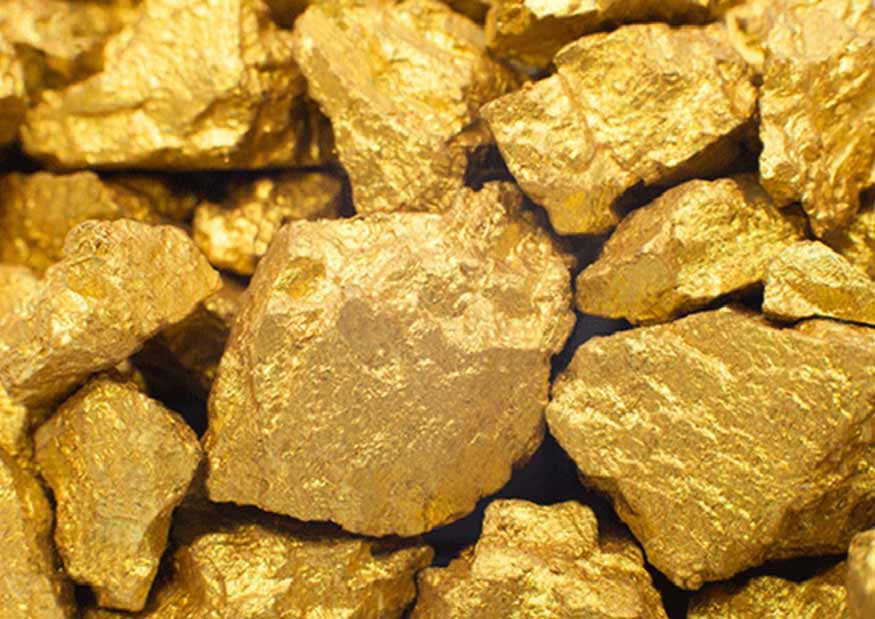
and a mysterious paper full of puzzling symbols and equations that must have held the secret of the philosopher stone.

The marquis, at first tried to understand and decode the mysterious paper with all of its puzzling magic symbols and equations, until he had these symbols engraved on the five gates of the villa Palombara and on the walls of the mansion, hoping that one day they would be translated.
The Alchemists of Riario Palace.

The marquis Palombara developed a passion for alchemy in 1656, when he visited the Roman court of Queen Christina of Sweden in Riario Palace (now known as Palazzo Corsini),

at the foot of the Janiculum Hill, that in modern days is seat to the National Academy of Lincei. Christine of Sweden was a devoted alchemist and scientist,
who was educated by the French mathematician and philosopher Cartesio, and also, she had and advanced laboratory supervised by the alchemist Pietro Antonio Bandiera. In Riario Palace an Academy was founded, to which the names of those 17th century illustrious figures are linked, such as Giuseppe Francesco Borri – an esoteric doctor born from a Milan noble family, the astronomer Giovanni Cassini,

the alchemist Francesco Maria Santinelli and the erudite Athanasius Kircher.

After Queen Christina of Sweden’s conversion to Catholicism, she decided to abdicate the throne of Sweden and she spent most of the rest of her life in Rome, from 1655 until her death in 1689.
Signs:

The symbols engraved on the Alchemic Door can be found among the illustrations of alchemic and esoteric philosophy books owned by Marquis Palombara.

Particularly, the drawing on the pediment of the Alchemic Door, with its two overlapping triangles and Latin inscriptions, is almost similar to the symbol that can be found on the frontispiece of Henricus Madatanus’ allegoric – alchemic book, called Aureum Seculum Redivivum.
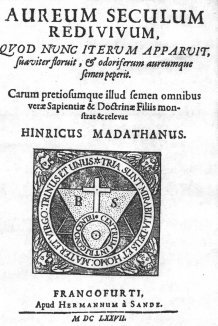
On the pediment of the Door is represented an emblem with on the inside the seal of David, contained in a circle with some Latin inscriptions, with the upper point occupied by a cross attached to an inner circle and the lower end by an hexagram with an oculus in it, which is the alchemic symbol of both the sun and gold. The frieze represents the emblem of the Rosacroce’s family, that can be found in many 17th century books and, maybe, it showed up for the first time in the title page of the book Aureum Seculum Redivivum.

The alchemic symbols along the doorframes follow, albeit with some small differencies, the sequence of planets associated to the correspondent metals: Saturn-lead, Jupiter-tin, Mars-iron, Venus-bronze, Moon-silver and Mercury-mercury. To every planet is associated a hermetic motto, following the direction indicated by the Jewish motto Ruach Elohim. Thus, this door must be read as the monument that marks the historic passage of the overthrow from exoteric Christianity symbols to the new spiritual model that was developing during the 17th century.
Inscriptions:

Both on the Villa’s walls and on the door itself there were some inscriptions. Even if Villa Palombara doesn’t exist anymore, some diggings brought to light inscriptions, better known as the Villa’s “missing inscriptions”. For instance:
“VILLAE IANUAM TRANANDO RECLUDENS IÀSON OBTINET LOCUPLES VELLUS MEDEAE. 1680”
- Passing by opening the door of the villa, Jason obtained the rich fleece of Medea 1680
“AQUA A QUA HORTI IRRIGANTUR NON EST AQUA A QUA HORTI ALUNTUR.”
- The water with which the gardens are watered is not the water that feeds them.
“CUM SOLO SOPHORUM LAPIS NON SALE ET DATUR SOLE SILE LUPIS.”
- Be satisfied of the only salt (knowledge) and of the only sun (reason)
“QUI POTENTI HODIE PECUNIA NATURAE ARCANA EMITUR SPURIA REVELAT NOBILITAS SED MORTEM NON LEGITIMA QUAERIT SAPIENTIA.”
- Who discovers the mysteries of nature to the powerful person, he himself is looking for death.
Inscriptions on the rose window.
“TRIA SUNT MIRABILIA DEUS ET HOMO MATER ET VIRGO TRINUS ET UNUS.”
- There are three marvels: God and man, mother and virgin, triune and one.
“CENTRUM IN TRIGONO CENTRI.”
- The center is in the triangle of the center.
Inscriptions on the architrave:
רוח אלהים (RUACH ELOHIM)
Spirit of God.
HORTI MAGICI INGRESSUM HESPERIUS CUSTODIT DRACO ET SINE ALCIDE COLCHICAS DELICIAS NON GUSTASSET IASON.
- A dragon guards the entrance of the magic garden of the Hesperides, and, without Hercules, Jason would not have tasted the delights of Colchis.
Inscriptions on the threshold

SI SEDES NON IS.
- an ambiguous quasi-palindrome, meaning both “If you sit, you do not go,” and “If you do not sit, you go.”
EST OPUS OCCULTUM VERI SOPHI APERIRE TERRAM UT GERMINET SALUTEM PRO POPULO
- It is an occult work of true wisdom to open the earth, so that it may generate salvation for the people.
Inscriptions on the doorframes
FILIUS NOSTER MORTUUS VIVIT REX AB IGNE REDIT ET CONIUGIO GAUDET OCCULTO
- Our dead son lives, returns from the fire a king, and enjoys occult conjugation.
SI FECERIS VOLARE TERRAM SUPER CAPUT TUUM EIUS PENNIS AQUAS TORRENTIUM CONVERTES IN PETRAM
- If you make the earth fly upside down, with its wings you may convert torrential waters to stone.
DIAMETER SPHERAE THAU CIRCULI CRUX ORBIS NON ORBIS PROSUNT
- The diameter of the sphere, the tau in the circle, and the cross of the globe bring no joy to the blind.
QUANDO IN TUA DOMO NIGRI CORVI PARTURIENT ALBAS COLUMBAS TUNC VOCABERIS SAPIENS.
- When in your house black crows give birth to white doves, then will you be called wise.
AZOT ET IGNIS DEALBANDO LATONAM VENIET SINE VESTE DIANA
- When azoth and fire whiten Latona, Diana comes unclothed
Mass culture
As many cases regarding mystery, that since the genesis attracts more and more people for its dark side and the following discover, and often this fact inspires, or better to say “forces”, many people to write books or to make documentaries, or even to make some citations in movies and videogames, both on the object itself and on its owner. Down below I report to you some examples:
Filmography:

In the famous movie “L’anno Mille” directed by Diego Febbraro, the monument serves as a portal between Middle Ages and the modern Rome.

In the first levels of the videogame “Tomb Raider – Chronicles”, the main character Lara Croft, visits Rome looking for the Philosopher Stone; to find it, she has to try to open the Alchemic Door.
Bibliography:
On the door:
“The Porta Magica – Rome”. The Journal of American Folk-Lore by Henry Carrington Bolton. It is the first modern study on the monument, with numerous inaccuracies in terms of transcription and traslation of inscriptions.

“La Porta Magica di Roma: studio storico” by Pietro Bornia.
“Il Segno del Messia: l’enigma svelato – L’Olismo Originario, la Porta Alchemica e l’archeoastronomia, Battaglia Terme” (2012) by Teodoro Brescia,
“La Porta Ermetica.” (1979) di Luciano Pirrotta.
“La Porta Magica. Luoghi e memorie nel giardino di piazza Vittorio.” (1990) di Nicoletta Cardano.
“Gli Argonauti a Roma. Alchimia, ermetismo e storia inedita del Seicento nei Dialoghi eruditi di Giuseppe Giusto Guaccimanni.” (2014) di Maria Fiammetta Iovine.

“La porta magica di Roma simbolo dell’alchimia occidentale.” (2015) di Mino Gabriele.
“La Porta Ermetica di Roma. Un itinerario spirituale fra simbolismo e alchimia.” (2015) di Nuccio D’Anna.
On Massimiliano Palombara:
“Marchese Massimiliano Palombara, La Bugia: Rime ermetiche e altri scritti. Da un Codice Reginense del sec. XVII” (1983), by Anna Maria Partini.
“Il giardino di Hermes: Massimiliano Palombara alchimista e rosacroce nella Roma del Seicento. Con la prima edizione del codice autografo della Bugia” by Mino Gabriele, 1986.
“Massimiliano Palombara filosofo incognito. Appunti per una biografia di un alchimista rosacrociano del XVII secolo” by Maria Fiammetta Iovine, 2016.
Fine
I hope you liked this second article on my blog and if so, leave a comment, share and like it. See you in the next one! Byeeeee.
 The Perks of Being Me
Lascia un commento